
Collections
Browse by Collections
Browse by Collections

Shop Paris & France Limoges boxes →
Limoges (pronounced lee-MOHZH) is a city of about 130,000 people in west-central France, on the banks of the Vienne River. It is the capital of the Haute-Vienne department in the Nouvelle-Aquitaine region, the area long known as the Limousin. For more than 250 years, the name "Limoges" has meant one thing to collectors around the world: the finest hard-paste porcelain made in France.
This guide covers what Limoges is famous for, a short history of the city and its porcelain, the best things to see when you visit, Christmas in Limoges, the latest news from the city, and how to recognize an authentic Limoges box. The photos and videos are our own, taken on our visit to Limoges in October 2026, plus a few taken in Limoges by our friend David at Rochard. Updated November 2026.

Can't make it to France? Bring Limoges home. Shop our collection of authentic Limoges porcelain, hand-painted in Limoges, France, or browse our Christmas Limoges boxes.
In this guide: What Limoges is famous for · History of Limoges · Limoges porcelain · Things to see · Limoges news 2026 · Christmas in Limoges · Getting there · Limoges boxes · Our photos · FAQ

Limoges is best known for three things:
Limoges began about 2,000 years ago as a Roman town called Augustoritum, built at a crossing point on the Vienne River. In the Middle Ages it grew around two centers: the "Château" around the Abbey of Saint-Martial, which drew pilgrims from across Europe, and the "Cité" around the cathedral. Many of the half-timbered houses and narrow lanes you can walk today date from these centuries.
The city's skilled craftsmen made Limoges famous for enamel in the Middle Ages and for porcelain from the 18th century on. In the 19th century, Limoges became one of France's great industrial centers, with dozens of porcelain factories and their tall brick kilns. The painter Pierre-Auguste Renoir was born in Limoges in 1841 and began his career as a young porcelain painter.


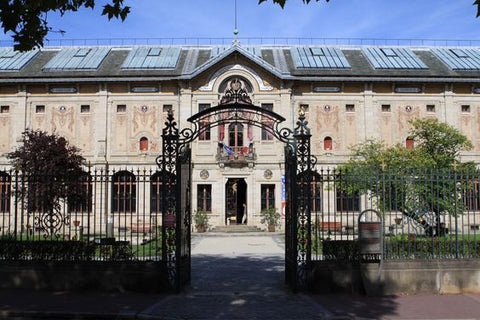
Limoges streets: the old La Bibliothèque brasserie (1896–2001) and classic stone buildings with iron balconies. Photo by Mira, Limoges Boutique, Limoges, October 2026
For centuries, Europeans tried to copy the white, translucent porcelain imported from China. The secret ingredient was kaolin, a pure white clay. In 1767–1768, a deposit of kaolin was discovered at Saint-Yrieix-la-Perche, a village about 25 miles (40 km) south of Limoges.
A favorite local legend says the clay was found by accident. During a soap shortage, Madame Darnet, the wife of a Saint-Yrieix surgeon, used a soft white earth from the area to clean her laundry. Her husband showed it to a local apothecary, who recognized it as very pure kaolin. Samples were sent to the royal porcelain factory at Sèvres, and the search for French "white gold" was over.


The three raw materials of Limoges porcelain on display: quartz, feldspar and kaolin, the white clay found at Saint-Yrieix. Photo by Mira, Limoges Boutique, at the Musée national Adrien Dubouché, Limoges, October 2026
Anne-Robert-Jacques Turgot, the royal administrator (Intendant) of the Limousin, saw the opportunity. In 1771 the first hard-paste porcelain factory opened in Limoges. A few years later it came under the protection of the Comte d'Artois, brother of King Louis XVI, and in 1784 the King bought it so that it could supply white porcelain to the royal factory at Sèvres. Many Paris porcelain studios also bought their white porcelain from Limoges, and in the 1800s most porcelain making moved to Limoges itself.
In 1842, the American porcelain importer David Haviland moved to Limoges to make china for the American market. His factory became one of the most famous names in porcelain, and it helps explain why "Limoges" is so well known in the United States today.
Limoges porcelain is still made in and around the city. Making a single piece takes dozens of steps: shaping, two firings at very high temperature, glazing, and finally hand decoration. See our photo tour of how Limoges boxes are made. To learn how to read the marks on the bottom of a piece, see our guide to Limoges marks, and our article on Limoges china vs. Limoges porcelain.
The must-see stop for anyone who loves porcelain. Founded in 1845, it holds the world's largest public collection of Limoges porcelain, along with ceramics from around the world and exhibits on how porcelain is made. It is on Place Winston Churchill in the city center. When we visited, we loved the displays of raw kaolin, real plaster molds and antique color test plates.


Inside the porcelain museum: a white biscuit sculpture and an antique hand-painted floral plate. Photo by Mira, Limoges Boutique, at the Musée national Adrien Dubouché, Limoges, October 2026
Limoges once had more than a hundred huge brick kilns. The Four des Casseaux, beside the Vienne River, is one of the last surviving porcelain kilns in the city, and one you can step inside to see how pieces were fired.

Limoges' Gothic cathedral took more than six centuries to build. Work began in 1273 and was only finished in 1888. Unusually, it is built of dark local granite. Inside, look for its stained glass and the carved Renaissance rood screen.
Behind the cathedral, the terraced gardens of the former bishop's palace step down toward the river and offer some of the best views of the city. The palace itself houses the Musée des Beaux-Arts, which has a remarkable collection of medieval Limoges enamels.

The old butchers' quarter is one of the most charming corners of Limoges, with medieval half-timbered houses along the short Rue de la Boucherie. Don't miss the tiny Chapelle Saint-Aurélien, the chapel of the butchers' guild, and the small Maison de la Boucherie museum.
This Gothic church is named for the two ancient stone lions that guard its entrance, and its tall spire is a landmark of the city skyline. It also has fine medieval stained glass.
Often called one of the most beautiful train stations in France, Limoges-Bénédictins was built between 1924 and 1929. Its dome and clock tower are an Art Deco masterpiece, and the station has appeared in films and in a famous Chanel perfume advertisement. At dusk, its lit clock face can be seen glowing over the rooftops from all over the city.


The Gare des Bénédictins clock tower, from the platforms and from the street. Photos courtesy of David at Rochard, Limoges, June 2023


The covered market, built of iron and glass, is decorated with a porcelain frieze. It is the place to taste local specialties such as Limousin beef, charcuterie and seasonal fruit.
This medieval stone bridge, built in the 13th century, crosses the Vienne below the cathedral. The riverbanks nearby are lovely for a walk.
Limoges calls its porcelain tradition les arts du feu, the arts of fire. The savoir-faire of the porcelainiers, the mouleurs who make the plaster molds, the décorateurs and the peintres sur porcelaine has been handed down from maître to apprenti for more than two centuries. Much of this work still happens in small family ateliers that are not open to the public, which is part of what makes a true boîte de Limoges peinte à la main so special. For visitors, the best places to see the craft are the Musée national Adrien Dubouché and the old Four des Casseaux kiln. To bring a piece of Limoges home, browse our collection of authentic hand-painted Limoges boxes, or meet the artisans of Limoges behind the craft.
Saint-Yrieix-la-Perche, where kaolin was first found, is a pleasant drive south of Limoges. Northwest of the city, the village of Oradour-sur-Glane has been preserved as a memorial to the 642 people killed there on June 10, 1944. It is a deeply moving place to visit.
Two short clips we filmed while walking the streets of Limoges in October 2026, a few weeks before the town hall fire.
On the evening of October 17, 2026, during nationwide protests over the cost of living, Limoges' historic Hôtel de Ville (town hall) was set on fire. The roof and the central clock tower collapsed, and much of the building was badly damaged. The neo-Renaissance town hall was inaugurated in 1883 and had been protected as a French historic monument since 1975. It had survived two world wars, and its loss has deeply saddened the people of Limoges.


The rest of the historic center, including the cathedral, the porcelain museum and the Boucherie quarter, was not affected. If you are planning a visit, check the city's official sites for any closures near Place Léon-Betoulle, where the town hall stands.
Every winter the city center turns into a Christmas village. According to the Limoges tourist office, the 2026 Christmas market runs from November 27 to December 27 on Place de la République and Place de la Motte, with wooden chalets, lights, free sledding and skating tracks, and a craft and local-producers market near the cathedral. Entry is free. Check the city of Limoges Christmas website for opening hours before you go.
Planning a visit? Read our full Limoges Christmas Market 2026 guide for dates, what to see and what to bring home.

Can't be in Limoges for the holidays? A hand-painted Limoges box is a little piece of French Christmas. See our Christmas Limoges boxes: Santas, Christmas trees, nutcrackers, ornaments and holiday scenes, all made and hand-painted in Limoges, France.
Limoges is about 240 miles (390 km) south of Paris. Direct trains from Paris-Austerlitz take about three and a half hours and arrive at the Gare des Bénédictins. For stations, tickets and day-trip tips, see our guide to getting from Paris to Limoges by train. The city also has its own airport, Limoges–Bellegarde, with seasonal flights from the UK and other European cities. Spring through early fall is the most pleasant time to visit, and December is magical for the Christmas market. Getting around town is easy on foot or by the city's buses and electric trolleybuses.


The Limoges box began as an 18th-century snuff box, a small luxury carried by fashionable French men and women. Today's Limoges boxes are miniature works of art: small hinged porcelain boxes in thousands of shapes, from hearts and eggs to animals, Paris landmarks and Christmas scenes. The first hinged Limoges boxes were brought to the United States in the mid-1960s, and Americans have collected them ever since.
An authentic Limoges box is made from Limoges porcelain, fired in the Limoges region, and painted by hand. Turn it over and look for:
Learn more on our history of Limoges porcelain page, or browse our traditional Limoges boxes.


Everyday Limoges: shopping streets, stone buildings and church spires. Photo by Mira, Limoges Boutique, Limoges, October 2026


Evening over the slate roofs of Limoges. Photo by Mira, Limoges Boutique, Limoges, October 2026
Limoges is in west-central France, about three hours south of Paris by train. It is the capital of the Haute-Vienne department in the Nouvelle-Aquitaine region.
Say lee-MOHZH, with a soft "zh" at the end like the "s" in "measure." "Limoge" without the "s" is a common misspelling.
Fine porcelain above all, along with medieval enamel work, Limousin beef and its Gothic cathedral.
The 1883 town hall was set on fire during protests on October 17, 2026. Its roof and clock tower collapsed and the building was badly damaged. The cathedral, museums and the rest of the historic center were not affected.
In 2026 it runs from November 27 to December 27 on Place de la République and Place de la Motte, according to the tourist office.
Yes. Porcelain houses such as Bernardaud, Haviland and Royal Limoges still produce porcelain in and around the city, and small family ateliers still hand-paint Limoges boxes, the traditional boîtes à pilules and boîtes à secret that collectors love.
Yes, especially if you love porcelain, art or history. Limoges is less crowded than many French cities, its historic center is easy to explore on foot, and it has the world's greatest porcelain museum.
A small hinged porcelain trinket box made and hand-painted in the Limoges region. Collectors give them as gifts for birthdays, weddings, holidays and milestones. Shop authentic Limoges boxes at Limoges Boutique.
{"one"=>"Select 2 or 3 items to compare", "other"=>"{{ count }} of 3 items selected"}


